

Welcome to lotus.seeds. In our previous explorations, we looked at the 20 Minute Dance—learning how to be loyal to our individual bodies—and the Village, where we expanded our awareness into the co-regulating intelligence of the social field. Today, we dive into what many consider to be an especially powerful aspect of Social Presencing Theater (SPT): the Stuck practice.
Social Presencing Theater is a wonderfully versatile discipline. Around the world, it is applied across remarkably diverse contexts—from supporting creative processes and personal growth to team development, executive leadership, and social innovation. Over the past eleven years of practicing and facilitating SPT—in education, executive workshops, and team trainings—my own primary focus has rested on team and personal development.
To be clear: I am not a psychotherapist. My role is that of a trainer, coach, and workshop facilitator. Yet, whether in corporate team building, leadership coaching, or personal growth, the exact same embodied principles operating in somatic therapy apply here. When we step out of our conceptual heads and into the wisdom of the physical body, transformation follows a universal language.
I share these reflections not as an expert with all the answers, but as a lifelong learner who remains deeply curious about the mysteries of body intelligence.
A Brief Flashback: The Weight That Wasn’t a Strategy
My first encounter with the Stuck practice happened in 2015 at a Presencing Institute foundation program in Berlin. At the time, I was searching for new ways to facilitate and lead transformation processes, curious about how Theory U could support systemic change in organizations. I expected strategic frameworks and conceptual tools—so discovering Social Presencing Theater under the guidance of its creator, Arawana Hayashi, was a surprising and deeply inspiring revelation.
I was at a frightening crossroad in my own life: I had walked away from a 30-year executive IT career, launched a startup, and hit a wall of severe exhaustion.
When Arawana introduced the Stuck exercise and it was my turn to step onto the floor, my rational mind naturally assumed I was working on a business strategy problem. But when I allowed my body to shape Sculpture 1, and three group members stepped in to embody the surrounding forces, something unexpected happened. Someone gently embraced me from behind.
In an instant, my cognitive story collapsed. My body revealed what my mind had hidden: It wasn’t a business issue at all. It was a deep, unacknowledged sense of social isolation and a heart longing for connection and belonging.
The physical relief that followed lasted for weeks; every step I took felt at least 50% lighter, as if a heavy backpack had been lifted from my shoulders. That short stuck exercise permanently altered how I view obstacles. It taught me that we don’t need to over-control life—we simply need to be present with what is.
To understand why this shift was so profound, let’s look at how the practice actually works.
What is the “Stuck” Practice? From Sculpture 1 to Sculpture 2
The beauty of the Stuck exercise lies in its radical simplicity. It takes the abstract, heavy feeling of being blocked and translates it into a concrete, visible, and felt reality.
The process unfolds through clear, ritualized steps:
Sculpture 1 (Current Reality): Instead of telling a long story about a problem, you allow the felt sense of your obstacle to shape your physical body into a posture—Sculpture 1. You intensify this shape, giving physical form to the internal or external forces that feel restrictive.
The Social Sculpture (Group Forces): In a small group setting, other participants step in intuitively to embody the specific forces that hold, push, or block your shape. Without words or drama, the invisible dynamics of your social field become physically visible.
The Gap of Silence: Once Sculpture 1 is fully established, everyone pauses. The group rests together in the quiet discomfort of the shape. We suspend our reflex to “fix” or “help,” allowing the active, analytical brain to settle into a quiet resting mode.
Moving to Sculpture 2 (The Emerging Future): Without planning or choreography, you allow your body to move when it feels an authentic physical impulse. You follow that movement until it naturally comes to rest in a new posture—Sculpture 2.
Harvesting Insights: Remaining in Sculpture 2, participants speak a single sentence from the “I-voice”—spontaneous words arising directly from the wisdom of the body shape (”first thought, best thought”).
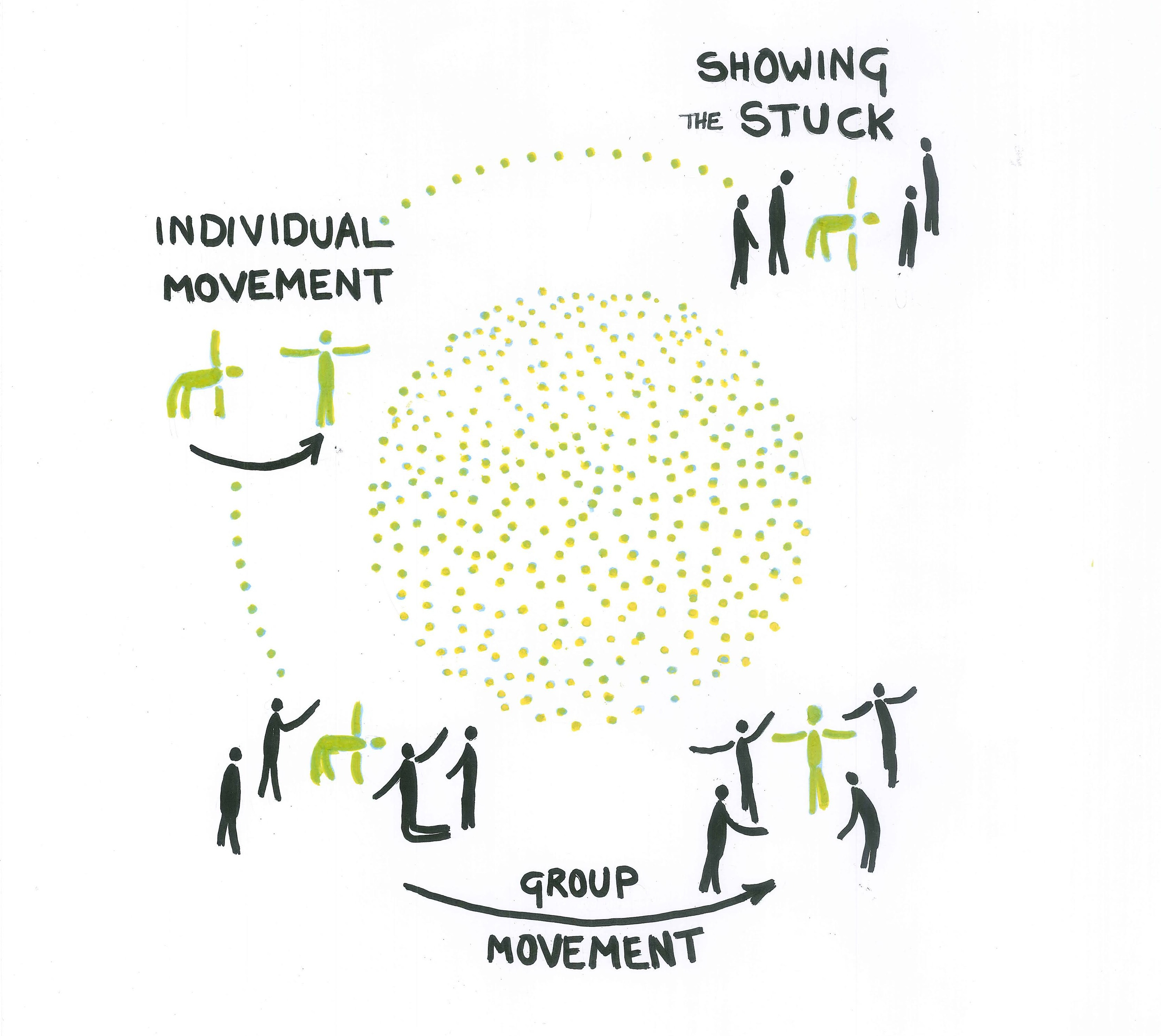
When we practice this, we make a subtle but profound shift from “I am stuck” (treating stagnation as a fixed identity) to “I have a Stuck” (observing a temporary physical condition).
When Rational Thinking Fails: The Somatic Roots of “Stuckness”
As modern neurobiology and somatic psychology show us, being “stuck” is not a mental failure or a lack of willpower. It is a biologically anchored, protective contraction in our nervous system.
THE LIMIT OF COGNITIVE ANALYSIS
Conceptual Thinking (Top-Down)
└─► “I know I should change, but I can’t...”
Somatic Memory & Nervous System (Bottom-Up)
└─► Holds protective tension & implicit safety responses
Through studying the literature of trauma researcher Bessel van der Kolk (The Body Keeps the Score), we learn that under stress or overwhelm, our brain’s verbal centers down-regulate. Our past burdens and protective habits are not stored as logical stories in our narrative memory; they live as sensory imprints, muscle armoring, and autonomic stress patterns. Because the story isn’t stored in words, talk therapy and rational strategy sessions alone cannot reach the deep layers where transformation occurs.
In his work on Embodied Self-Awareness, researcher Alan Fogel makes a vital distinction:
Conceptual Self-Awareness: Thinking about ourselves, analyzing, judging, and interpreting. This keeps us trapped in our heads.
Embodied Self-Awareness: The felt, present-moment perception of bodily sensations.
My own understanding of this depth grew immensely during an intensive one-year training in Gabor Maté’s Compassionate Inquiry, during which I was also introduced to the principles of Hakomi and acquired its foundations through several specialized programs. Gabor Maté invites us to reframe how we look at uncomfortable patterns. Instead of asking “Why are we stuck?”, he invites us to ask: “Where sits the pain in your body, and what is the behavior pattern doing for you right now?”. Every stuck posture was once a brilliant, self-protective mechanism created by the body. In SPT, we don’t fight or try to strip away the obstacle; we honor it.
The Wisdom of Wu Wei: Letting Change Emerge
This somatic understanding bridges beautifully with ancient Eastern philosophy. In Chapter 57 of the Tao Te Ching, Laozi starts with:
“If you want to be a great leader,
you must learn to follow the Tao.
Stop trying to control.
Let go of fixed plans and concepts,
and the world will govern itself.”
Laozi highlights the difference between rigid, man-made control and the organic, self-organizing order of nature. When we try to force a solution top-down, we create friction and rigidity.
This is also the essence of Wu Wei—action through non-forced presence. In the Stuck exercise, when we hold Sculpture 1 without rushing to “fix” it, we practice Wu Wei. We allow the accumulated tension (potential energy) to naturally discharge and transform into a fresh physical impulse (kinetic energy).
THE MOVEMENT OF TRANSFORMATION
1. Sculpture 1: Embodying What Is
2. The Gap of Silence: Suspending Control (Wu Wei / Non-Doing)
3. Sculpture 2: Allowing the Emerging Future
As Arawana Hayashi writes in her book Social Presencing Theater: The Art of Making a True Move:
“Stuck is not a problem. Stuck is not sustainable. Stuck knows what to do next.”
From Personal Shift to Systemic Impact: Leadership, Teams, and Global Crises
When we experience the transition from Sculpture 1 to Sculpture 2, something subtle yet radical shifts in our inner posture. We realize that we do not need to control or overpower a situation to move forward.
What happens when this shift moves beyond the individual practitioner and enters our teams, our organizations, and our collective response to societal challenges?
THE PARADIGM SHIFT IN LEADERSHIP
Old Paradigm: Top-Down Control & Fixing
└─► Reacting with anxiety, forced plans & micromanagement
Emerging Paradigm: Somatic Presence & Field Intelligence
└─► Staying with “what is”, trusting self-organization
In team settings, most conflicts stall because everyone is fighting for their own conceptual narrative of “who is right”. When a team translates its impasse into a shared physical sculpture, the defensiveness melts away. Nobody can pretend that the tension isn’t there, yet nobody feels individually blamed. As Arawana Hayashi reminds us: “Nobody is stuck by themselves.”. By embodying the web of forces together, leaders and team members develop a shared empathy and discover what Danish educator Michael Stubberup calls “the smallest possible change”—a subtle, unforced move that shifts the whole system without triggering defensive pushback.
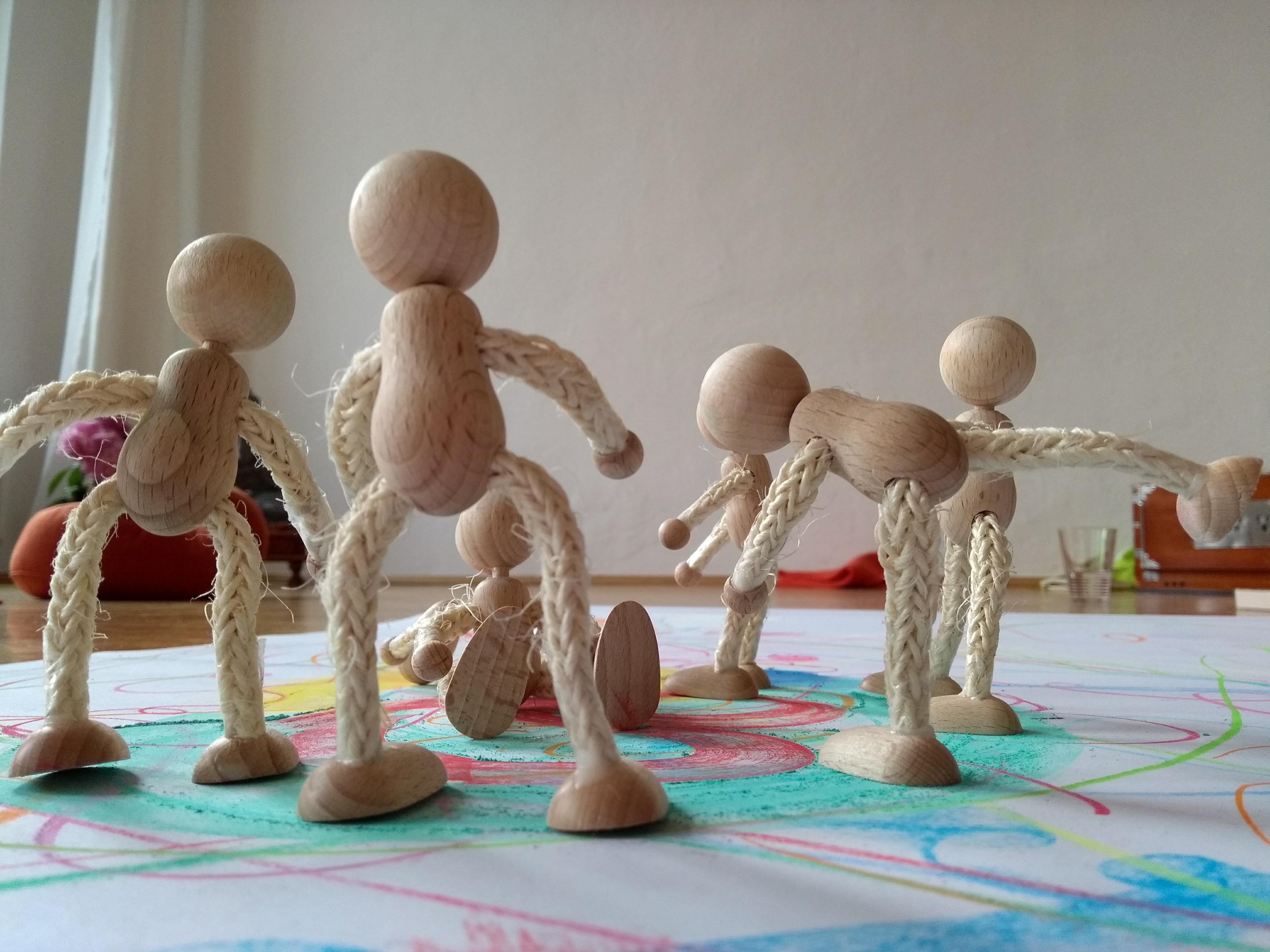
On a broader societal level, this somatic capacity may be the missing link in addressing today’s complex crises—from ecological breakdown to political polarization. We do not lack scientific data, technological concepts, or sustainability plans. What we lack is the capacity to remain present with the discomfort of "what is." Faced with overwhelming global challenges, our collective nervous system often freezes or defaults to frantic, top-down enforcement. Consequently, we attempt to resolve climate or organizational crises using the very mindset of over-control that caused them in the first place.
The Stuck exercise offers a quiet, revolutionary alternative. It trains us—as leaders, citizens, and changemakers—to build our emotional “window of tolerance”. It teaches us to sit with the complexity and pain of a situation without rushing into superficial fixes. When we stop panicking and allow ourselves to feel the reality of our current world, we stop wasting energy on denial or cynicism. We open a space where genuine, organic solutions can emerge—not from an ambitious ego, but from the wisdom of the whole field.
💡 11 Years of Practical Insights: A Sharing for Facilitators and Coaches
Over more than a decade of sharing this work in educational courses, team coachings, and as an exchange in our monthly Anwender-Café [Practitioner Café], I have gathered practical nuances and adaptions that became optional add-ons when hosting this practice:
1. Start with the Body, Not the Narrative
In the past, I used to ask participants: “Where in your life do you feel stuck?”. I noticed that this immediately sent people’s eyes up to the ceiling, searching for current situations and stories about their careers or relationships.
Today, I often bypass the story altogether. I invite a somatic check-in: “Where in your physical body do you feel tightness, weight, a blockage, or an energy deficit right now?”. Asking participants to build a shape around that physical sensation leads to far deeper, more authentic shifts without getting lost in cognitive drama.
2. “The Bodies in the Room Are Listening”
When demonstrating the exercise as a facilitator, don’t just explain it verbally. Stand in the center of the room, take a deep, slow breath, ground yourself, and embody a real, current Stuck.
When you pause in Sculpture 1 and hold “the gap” of silence before moving, the bodies in the room tune in. The audience’s active, analytical brains drop into a quiet waiting mode. You are communicating body-to-body that working through a Stuck isn’t about performance or playing, but about allowing real change to emerge with authenticity.
3. Solo Stuck vs. Group Field Intelligence
While individual Stuck practice offers great personal insights, the Group Stuck reveals the power of the social field.
An advanced variation I love to offer: Instead of having the case-giver manually place every group member into position (which can sometimes reactivate the analytical brain), invite the group members to listen to their own bodily wisdom. Once the case-giver takes their Stuck shape, the others move in intuitively to position themselves in relationship to that shape. This taps into collective field intelligence and self-regulation. It follows the way roles are called in a 4D mapping, where stakeholders find their position by following their embodied wisdom without being guided into a specific position.
4. Service Without “Helping”
Our natural human condition is to want to “fix” things and relieve others of their pain. But true service in SPT means holding space without trying to help.
If a group member feels a clear physical impulse to apply pressure or hold someone down in Sculpture 1, that authentic tension often provides far greater clarity for the case-giver than a superficial, premature attempt to “rescue” them.
5. Embracing “Nothing Happened”
Sometimes a participant finishes Sculpture 2 and says: “I didn’t feel anything. It didn’t work for me.”.
As a facilitator we have to accept that the Stuck practice isn’t a one-size-fits-all solution, nor will it yield an obvious breakthrough for every person, every time. As facilitators, we don’t need to defend the method or play the expert when someone feels untouched by the exercise. We can simply hold space with trust, knowing that somatic integration moves at its own pace—often unfolding silently beneath the surface and revealing its impact days or weeks down the road.
5. Meeting Resistance as a Gold Mine (The Ultimate Facilitator Test)
In workshops, it is completely natural for participants to encounter resistance—skepticism, discomfort, or an urge to pull back from embodied practices. Our initial reflex as facilitators might be to justify the method, persuade the participant, or push through the tension.
Yet, handling resistance offers perhaps the ultimate test of whether we have merely taught the Stuck exercise or truly internalized its wisdom. If “every Stuck is a gold mine,” then a participant’s resistance is not a disruption to the practice—it is the Stuck in the room.
When we give that resistance radical space and turn toward it with genuine, open-hearted curiosity rather than defense, we embody the very essence of the exercise. We stop fighting “what is.” By honoring the resistance as a wise, protective response of the participant’s system, we create a safe container where true relaxation and emergent insight can actually begin.
In Conversation: Exploring the Edge of Practice
As I continue to host these spaces and learn alongside practitioners around the world, I find myself returning to a few open questions:
For Facilitators: How do you navigate that delicate threshold between giving enough structure to keep beginners safe, and stepping back so the field can self-regulate? Where do you notice your own urge to “help” creeping in during a Group Stuck?
For Leaders & Coaches: When you look at your current organization or community, where might a seemingly intractable problem actually be a “gold mine”—a place where the system is simply holding potential energy before its next true move?
For Everyone: What changes in your body right now when you drop the mental story behind a current challenge, and simply welcome the physical sensation of “what is”?
I would love to hear your thoughts, your somatic realizations, or your questions from your own facilitation practice in the comments below.
Deepen Your Practice: Resources, Practice Groups & Upcoming Offerings
If you feel inspired to explore the Stuck exercise and other embodied practices, I warmly invite you to connect with our growing community:
🌍 Global Practice Groups & International Resources
SPT Practice Groups Worldwide
SPT practice groups are community-led, self-organized spaces for peer learning and sharing, where participants can explore and deepen their understanding of Social Presencing Theater. New groups are continually forming around the world.
Check the SPT Practice Session Offerings to find a group near you.
🇩🇪 Local Offerings in Germany & Online (with Dirk Bräuninger - Late 2026)
SPT Grundlagen Herbst 2026 (Frankfurt): Foundational weekend course at Die Halle (Nov 14–15, 2026).
SPT Aufbaukurs Winter 2026 (München): Advanced practice weekend (Dec 12–13, 2026).
Continuous Practice & Community:
SPT Anwender-Café [Practitioner Café]: Monthly online gathering for facilitators (every 4th Wednesday of the month at 16:00).
Open Movalogue Call: International monthly call (every 3rd Tuesday of the month at 16:00).
Find registration links, details, and my coaching offerings at dirkbraeuninger.de.
📚 References & Further Reading
Hayashi, Arawana (2021). Social Presencing Theater: The Art of Making a True Move.
(The foundational manual for the Stuck practice, 20 Minute Dance, and Village exercises).Van der Kolk, Bessel (2014). The Body Keeps the Score: Brain, Mind, and Body in the Healing of Trauma.
(Explores how stress and implicit memory are stored in the body and why top-down verbal therapy often fails to reach non-verbal brain structures).Fogel, Alan (2009). The Psychophysiology of Self-Awareness: Rediscovering the Lost Art of Embodied Self-Awareness (Norton Series on Interpersonal Neurobiology)
(Distinguishes between Conceptual Self-Awareness and Embodied Self-Awareness).Maté, Gabor (2022). The Myth of Normal: Trauma, Illness, and Healing in a Toxic Culture. Avery / Compassionate Inquiry Methodology.
(Reframes protective mechanisms not as pathology, but as somatic adaptations to pain).Laozi (Lao Tzu). Tao Te Ching (Chapter 57).
(Explores the principle of Wu Wei—action through non-forcing—and the natural self-organization of living systems).Trungpa, Chögyam (2008). True Perception: The Path of Dharma Art.
(Source of the principle “first thought, best thought” and the foundational posture of non-aggression).Stubberup, Michael & Steen Hildebrandt (2012). Sustainable Leadership from the Heart.
(Introduces the concept of “the smallest possible change” in complex systems).
A note on the creation of this article: This text originated from a series of self-recorded audio reflections and collaborative harvesting. To bring these spoken thoughts into a written format, I used the AI tool NotebookLM to transcribe, structure, and translate the content into English. Finally, I personally reviewed, refined, and edited the entire text to ensure it truly reflects my voice and experience before hitting publish.